Emface: a non-surgical face lift for the jawline, cheeks and brow
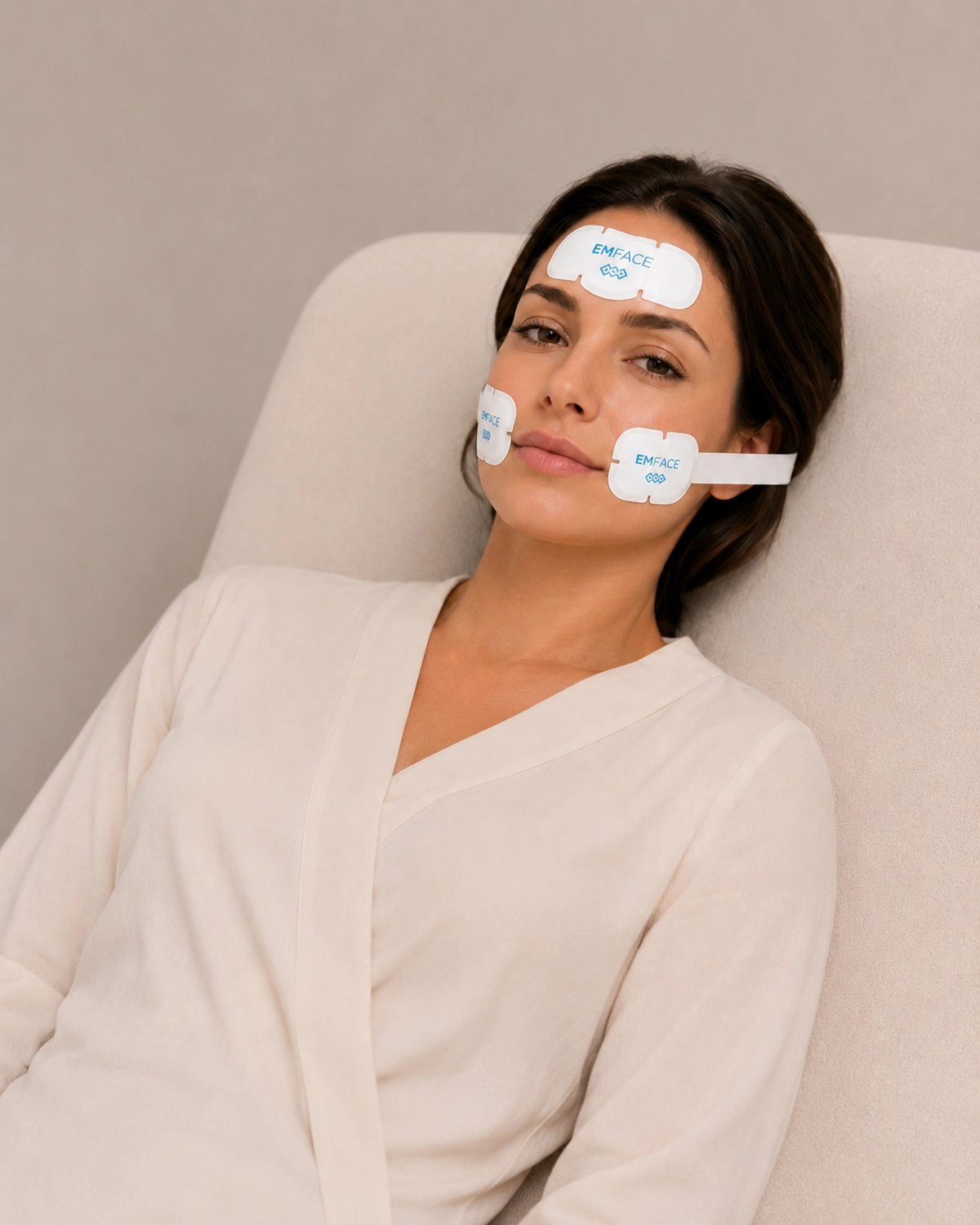
Emface is our face-lift treatment for people who don't want needles or surgery. It tightens the skin, as most energy devices do. What sets it apart is that it also strengthens the facial muscles beneath the skin, a layer skin-tightening devices don't reach. That is where the deeper structural lift comes from, because a stronger muscle layer supports the skin in a way that tightening the skin alone cannot.
- Nothing injected, no needles
- No pigment target, so skin tone is not a barrier
Consultations are free, 20 minutes with the doctor. You leave with a written plan and the exact price.
Does it work, and for whom
Measured three months after a course of four treatments. Lift and wrinkle figures are from peer-reviewed studies; muscle tone is the manufacturer's data on file.
Emface does most for a face where the support has started to soften but the tissue is still light. That is early blurring of the jawline, a brow that has begun to sit heavy, the first softening under the chin. In those faces, rebuilding the muscle beneath the skin gives a visible lift, and it does it without adding anything.
It does least where the problem is excess skin. Heavy jowls or loose skin that has stretched will not be lifted by muscle tone, and I will say so. That is a surgical question. It also does not replace lost volume, and if lines are the main complaint, anti-wrinkle treatment does that more directly and for less.
Where the surface is the issue, meaning texture, pores or scarring, that is SkinPen or Exion territory. Emface is for lift and definition.
Choose the zones you're thinking about
Emface is priced by the number of zones. Tap the areas you're thinking about and the price updates. Which zones are worth treating is confirmed at the free consultation.
Not sure yet? A single session is £350 for one zone. If you go on to a course within ten days, it counts as your first session and the balance is the course price. Book one session
How you pay. You pay nothing before your consultation. If you go ahead, you can pay for the course in one go, or split it into four equal payments at 0%: the first when you book, the rest over the following months. Bigger courses can be split into more. No fees, no credit check. How the plans work.
Founding patient terms
The founding patient discount applies to one qualifying Emface course of four or six sessions, once per patient, while places remain within the first 25 course plans. It does not apply to future repeat courses, maintenance courses, top-ups or single-session bookings, and is not a permanent price lock. Not valid with other offers, except the combined Exion and Emface booking discount.
Two layers, treated in the same session
As the facial muscles lose tone with age, the skin above them sits lower and the jawline and cheeks lose their line. Emface treats both layers in the same session.
The applicator delivers two kinds of energy at once. Radiofrequency heats the skin layer gently, and the skin responds by building new collagen and elastin, so it tightens. At the same time, HIFES, a form of electrical stimulation, makes the facial muscles contract thousands of times in twenty minutes. The muscle responds the way any muscle does to work: it gets denser and firmer. So the lift comes from support being rebuilt beneath the skin, not from anything added on top.
What a session involves
Around 35 minutes in total. Up to three zones run together in one 20-minute pass, unless cheeks and eyes are both treated: those applicators overlap, so that session, and full face, runs as two passes. Allow around 50 minutes. No numbing is needed, and there is no recovery period.
Before you come
- Arrive with clean skin and no make-up on the treatment areas
- Remove earrings, piercings and any jewellery around the face and neck
- Eat normally; there is nothing to prepare or avoid
- Free parking on the square after 5:30pm and at weekends
There is no aftercare. Make-up can go on straight away.
Check before you book
If any of these apply, message us before booking.
- Pacemaker, defibrillator or any implanted electronic device
- Metal or permanent implants near the treatment area
- Pregnant, breastfeeding or having IVF
- Isotretinoin in the last 12 months
- Blood-thinning medication or a bleeding disorder
- Cancer, current or past, or a skin cancer history
- Epilepsy, multiple sclerosis or another neurological condition
- Diabetes that is not well controlled
- Surgery, peel or resurfacing in the area in the last three months
- Active skin condition, infection or cold sore on the area
- Reduced skin sensation in the area
- Under 18
What to expect, and when
The result is not there when you leave the chair. It develops over the weeks after the course, as new collagen matures and the muscle holds its tone.
Questions answered
Does it hurt?
No. Most people describe firm muscle contractions and mild warmth, a bit like an intensive facial workout. It can feel odd for the first minute. The intensity is set to your comfort and can be lowered at any point in the session. No numbing cream is used.
How much does it cost?
Courses of four are £1,080 for one zone, £1,440 for two, £1,710 for three and £2,250 for the full face and eyes at founding patient prices; standard prices are 10% higher. A single session is £350. The consultation is free. You can pay for a course in one go or split it into equal payments at 0%.
How does Emface compare with anti-wrinkle injections or filler?
They do different jobs. Anti-wrinkle injections relax the muscles that make lines, so they smooth lines but do not lift. Filler adds volume where it has been lost. Emface strengthens muscle and firms skin, so it lifts and defines without adding anything. If lines are the main issue, injections are the more direct answer. If the face has dropped rather than emptied, Emface is the more relevant one. The three can be planned together.
How does it compare with a surgical facelift?
A facelift removes and repositions skin and tissue. It is the only treatment that deals with genuinely excess skin, and its results last for many years. Emface does not cut, does not remove skin and cannot match that scale of change. It suits people with early to moderate softening who want a lift they can have in a lunch hour. It is not a substitute for surgery in someone who needs surgery, and the consultation will say which you are.
Is it suitable for darker skin?
Yes. Emface does not use light or laser energy, so there is no pigment target and nothing that heats melanin. Skin tone is not a barrier to treatment. The manufacturer's published studies covered Fitzpatrick types I to IV; treatment in deeper tones follows the same protocol and the same comfort and safety checks.
Combining Emface with Exion
Emface rebuilds the muscle support; Exion firms and thickens the skin above it. Where both are needed, they are planned as one course, and booking both together is 5% off the combined price.
What Emface is
A BTL device delivering radiofrequency and HIFES (high-intensity facial electrical stimulation) together through hands-free applicators. A registered medical device used in line with its intended purpose.
- Kinney BM, Boyd CM. Remodeling of facial soft tissue induced by simultaneous application of HIFES and synchronized radiofrequency provides nonsurgical lift of facial soft tissues. J Cosmet Dermatol. 2024;23(3):824–829. doi:10.1111/jocd.16165
- Gentile R, Halaas Y. Novel approach to facial rejuvenation by treating cutaneous and soft tissue for wrinkles reduction: first experience from multicenter clinical trial. Facial Plast Surg Aesthet Med. 2024;26(1):1–6. doi:10.1089/fpsam.2023.0015
- Goldberg DJ et al. Treatment with synchronized radiofrequency and facial muscle stimulation: histologic analysis of human skin for changes in collagen and elastin fibers. J Cosmet Dermatol. 2024. doi:10.1111/jocd.16273
- Frank K, Kaye KO et al. Effect of synchronized radiofrequency and high-intensity facial electrical stimulation of the upper face. Aesthet Surg J. 2025;45(5):525–530. doi:10.1093/asj/sjaf009
- Muscle tone figure: manufacturer clinical data on file, BTL Industries.
Medically reviewed by Dr Gohar Shah, GMC 6127983 · Last reviewed 14 September 2026
Book your free consultation
Twenty minutes with the doctor: what has changed in your face, which zones are worth treating, and a written plan with the price, at the clinic in Bethnal Green. No obligation.