SkinPen® microneedling for acne scars, texture and fine lines
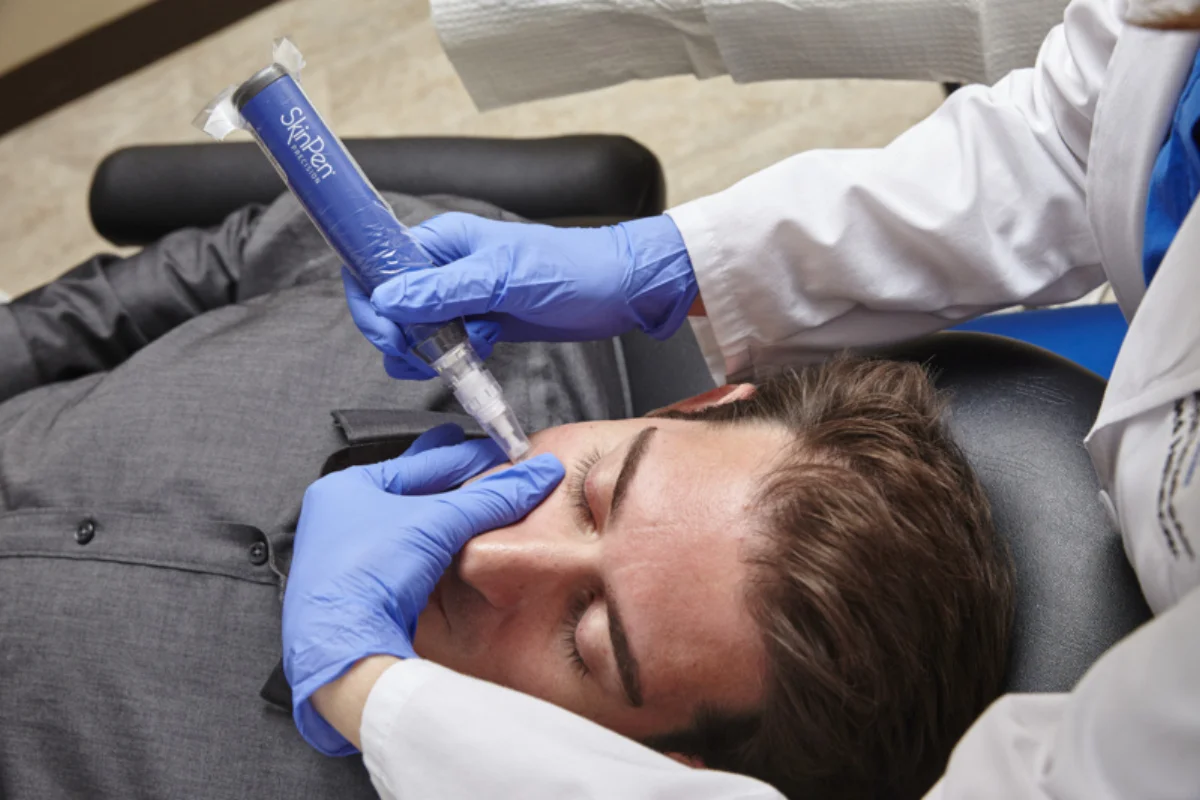
Microneedling is a minimally invasive treatment aimed at improving skin quality, performed here with the SkinPen® device. Controlled micro-channels at a set depth stimulate the skin's own collagen renewal, improving scarring, texture and tone over the months that follow. No product is added; the skin does the work.
- Clinically proven for all skin tones, including darker skin types
- Improves acne scars, fine lines, enlarged pores and uneven texture
- Adjustable needle depth for precise, personalised treatment
Build your course
Face and neck are treated together as standard. Décolletage or a body area can be added. The price updates as you select. Areas and treatment plan are confirmed at consultation.
Texture, pores, lines
Face and neck · 3 sessions · 3 to 4 weeks apartAcne scarring
Face and neck · 3 sessions to start · 4 to 6 weeks apartPigmentation and tone
Face and neck · 3 sessions to start · shallow depth · 2 to 4 weeks apartWhat the evidence shows for SkinPen
Results from the manufacturer's clinical study of 20 patients with facial acne scarring: three treatments, assessed from standardised photographs by two independent dermatologists blinded to timepoint.
Microneedling comes in two forms, and they are not interchangeable. SkinPen is mechanical: needles only, no heat. It carries the lowest pigmentation risk of any collagen-stimulating treatment, which matters in darker skin. It is the right tool for acne scarring, enlarged pores and uneven texture, because those are structural faults in the upper dermis, and that is what needling remodels.
What SkinPen does not do is tighten. If scarring, pores or texture is your concern, that does not matter, and SkinPen is the right choice at any age. If lifting or firming is what you want, it is the wrong tool. Laxity comes from loss of dermal support, not from surface damage, and needling alone does not restore it. Where the surface and the support both need work, Exion radiofrequency microneedling adds heat to the needling and firms the dermis as it remodels. Where lift is the whole aim and the surface is good, Emface does it without needles at all. I would not recommend SkinPen for tightening.
Depth determines the result
Treatment that is too shallow produces little change. Treatment that is too deep in the wrong area risks marks that outlast the original scar. Each session begins at 0.25 mm and progresses only until the skin shows the intended response. The figures shown are the manufacturer's upper limits for each region. A home dermaroller works at a single fixed depth across the whole face.
In darker skin (Fitzpatrick IV to VI), the manufacturer notes that pigment may darken briefly before it lightens. Treatment begins conservatively and is adjusted at each session.
What a session involves
Around 45 minutes in total. Dermalux LED afterwards is optional at £40.
Before you come
- Stop retinoids and acids 24 hours before, 3 days if your skin is sensitive
- No sunburn or fake tan on the area
- Arrive without makeup, and having eaten
- Free parking on the square after 5:30pm and at weekends
Is it right for you? Quick check
Tick any that apply. If any applies, please message before booking.
Aftercare, in short
- Only the products provided on the skin for the first 24 hours
- Mineral sunscreen daily for two weeks
- Avoid sweaty exercise, sauna, swimming and sun for 72 hours
- No retinoids, acids or makeup for three days
- No other facial aesthetic treatments for a month
Full written aftercare is provided after the first session.
Day by day
Select a treatment day to see how the skin typically settles. Most patients return to normal activity the following day. Redness usually resolves within one to three days; dryness can persist for up to a week.
Course timeline and expected results
Questions answered
Does it hurt?
A topical numbing cream is applied for around 20 minutes before treatment, so most patients describe the sensation as mild prickling or light vibration rather than pain. Bony areas such as the forehead and jawline can feel slightly sharper.
What happens at the free consultation?
Around 20 minutes with the doctor. It covers skin type, scar type, appropriate depth and number of sessions, and ends with a written plan and a confirmed price. If SkinPen is not the right treatment, you will be told.
How much does it cost?
Face and neck is £200 per session, paid on the day. A course of three is £600. Where scarring or pigmentation needs more, sessions four to six are £160 each, so six sessions come to £1,080. The consultation is free.
How many sessions for acne scars, and what if I'm not improving after three?
Everyone starts with three, spaced four to six weeks apart. Fine lines and texture often respond within three. Established acne scarring sometimes needs more, up to six, and that is decided at review, not at booking. At the third session, standardised photographs are compared with baseline and the decision to continue is made together. If the skin is not responding, treatment stops.
When will I see results?
Early changes in texture and tone typically appear from around four weeks after the first session. The most visible improvement develops over three to six months as new collagen continues to remodel, and remodelling can continue for up to a year after the final session.
Can SkinPen be combined with other treatments?
Yes. SkinPen is often combined with skin boosters such as Profhilo or Ameela for hydration, with Sunekos for amino-acid-based renewal, or with Exion radiofrequency where tightening is the aim. Combinations are planned in the correct order and spacing at consultation.
How long will I be red?
Redness usually settles within one to three days. Dryness and flaking may continue for up to a week. If this is a concern, plan the first session for a quieter few days.
Can I have it if I've had anti-wrinkle injections or filler recently?
Yes, with appropriate spacing. The manufacturer advises avoiding other facial aesthetic treatments for a month after each SkinPen session. Sequencing is planned at consultation.
How is it different from a dermaroller?
They are not equivalent treatments. SkinPen is a medical device with sterile single-use cartridges and adjustable needle depth, used in clinical settings. Home dermarollers are fixed-depth devices reused over time, with a higher risk of skin damage and infection.
Can I pay in instalments?
There is nothing to pay up front. Each session is paid on the day, so the cost is already spread across the course. If you would like to spread it further, ask about our payment plans at consultation.
What SkinPen® is
A medical-grade microneedling pen. It makes thousands of controlled micro-channels in the skin, which triggers new collagen and elastin. Nothing is injected. The skin improves itself. It was the first microneedling device to receive FDA clearance and is backed by published studies across all skin types.
- SkinPen Precision pivotal clinical study, Fitzpatrick II to VI, summarised in the Instructions for Use
- Chopra et al, Aesthetic Surgery Journal, 2015
- Nedelec et al, Skin Research and Technology, 2016
- Alster and Li, microneedling of scars, Plastic and Reconstructive Surgery, 2020
- Journal of Clinical and Aesthetic Dermatology, December 2023
Book your free consultation
Treatment begins with a 20-minute doctor-led consultation at the clinic in Bethnal Green: skin assessment, scar mapping and a written plan with the price. No obligation. If SkinPen is not right for you, you will be told.